

(Published in the Star on 7 Nov 2012)
In lesson five, you will learn about the “mechanism” of coaching or the steps to take in a successful coaching relationship. In doing this, we will take you through a 10-part coaching journey of a known Coaching Model, which clearly spells out what a coach needs to do at every interval.
Why does Coaching Need a Model?
One key reason why Coaching is powerful is because it has a structured process that sits inside an integrated model similar to a high level strategy that allows the coach to “see the battlefield” and respond adequately to whatever coaching situation.
Coaching Models
Coaches use a variety of models. The common ones are the GROW, SUCCESS, STEPPA and the 3 Stage Model (developed by Corporate Coach Academy).
Many coaching models exist because Coaching integrates many fields of knowledge and disciplines. Among them are Psychology, Neuro-Linguistic Programming, Sociology, Management, Leadership, Business, Strategic Thinking and many others. Different coaching schools emphasise the use of different fields of these knowledge and disciplines. Some are more psychological-based; some are more performance-based and so on. There should not be too much worry over this as many of these coaching models are founded on many common values, such as:
• The establishment of a relationship that is built on trust, unfeigned communication and confidentiality
• The formulation of client-based, agreed upon goals and expectations
• The dynamics of powerful questioning and listening to propel the coachee towards his goal
Coaching Model Used by the Malaysian Association of Certified Coaches
Most members of this body have been trained to use the 3 Stage Coaching Model. This is a homegrown coaching model developed by Corporate Coach Academy (CCA) in 2001. It is widely used because it is a “hybrid” model that took the best out of the GROW and STEPPA Coaching Models. The purpose for doing this is to have a more reinforced model that is both more “comprehensive” and compact that can guide the coaches more closely to perform all critical tasks that will lead to greater effectiveness and results. Additionally, it took in all the fields of knowledge and disciplines that guide the coach to be a multidisciplinary or all-round expert.
Details Of The 3 Stage Coaching Model?
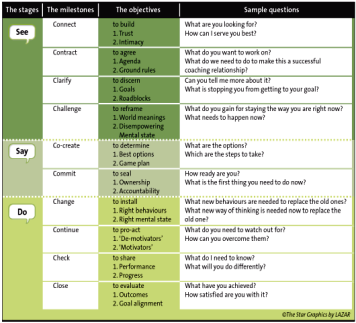
The 3 Stage Model is made up of three (3) key stages called the “See”, “Say” and “Do”. The “See” focuses on the work of the coach in raising the coachee’s self-awareness for him to “see” the opportunities beyond his mental horizons. The “Say” focuses on getting the coachee to say what they will do so that it commits him to taking ownership of the goal. Finally, the “Do” gets the coachee to take the required actions that will lead him to his goal.
Graphically, the 3 Stage Model is expressed as follows: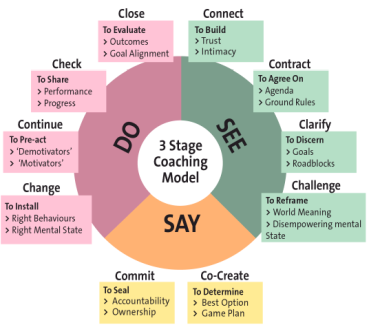
 How Much Did You Learn From Here?
- Why is a coaching model important for powerful coaching?
- What are some common values in most good coaching models?
- What are the three key stages of the 3 Stage Coaching Model?
- What are the 10 coaching milestones present in the 3 Stage Coaching Model?
- What other insights do you gain from this lesson?
Comments are closed.